Work Is Important Enough Not to Become Everything
In brief
In brief
Work can be a serious source of craft, responsibility, and meaning without becoming a complete identity. A healthier relationship with ambition protects the parts of life that employment cannot reliably validate or replace.
- The problem is not caring about work; it is asking work to prove personal worth.
- A good job can remain meaningful while sharing identity with relationships, rest, and private commitments.
- Boundaries protect sustained ambition by preventing every setback from becoming an existential verdict.

I recently read Simone Stolzoff's The Good Enough Job: Reclaiming Life from Work. The part that stayed with me was not an anti-work argument. The book is more useful than that.
Its harder point is that work can be genuinely important, and that this is exactly why it should not be asked to become everything.
That distinction feels worth holding onto. A lot of criticism of modern work culture becomes too easy because it begins by treating work as fake meaning: jobs are just paychecks, ambition is vanity, and a healthier life begins once we care less. Sometimes that critique is deserved. Work can become a status machine. It can give people a language for justifying exhaustion. It can turn ordinary career signals into evidence of personal worth.
But I do not think the answer is to pretend work does not matter.
Work is often where vague interest becomes real ability. It is where a person learns discipline, taste, cooperation, responsibility, and craft. It is where private intelligence has to meet the resistance of the world. A project either works or it does not. A paper either contributes something or it does not. A team either coordinates or falls apart.
The problem is not that we care about work. The problem is that we often ask work to answer questions it cannot reliably answer: Who am I? Am I valuable? Do I belong? Has my life been well spent?
That is too much weight for a job.
Why Work Gets So Large
Work did not become psychologically central only because people became vain or confused. It became central because it organizes many of the practical facts of adult life.
It affects where people live, who they meet, how their time is structured, what risks they can take, what status they receive, and what future they can imagine. For many people, the workplace is one of the few durable institutions they encounter every day. It supplies schedule, social contact, evaluation, narrative, and a vocabulary for explaining oneself.
So work identity is not just an illusion floating above reality. It is partly built into reality. A job title often does say something about training, obligations, social world, and daily attention. A career path can shape confidence, habits, taste, and ambition.
The danger starts when a partial truth becomes a total explanation.
If work shapes my life, it is tempting to say work is my life. If work reveals some of my ability, it is tempting to say work reveals my worth. If work gives me a place in the world, it is tempting to think losing that place means losing the self.
Professional culture often encourages this slide because it is useful. A person who treats work as identity will usually give more than the contract asks.
But the slide is still a slide. A job can shape a life without becoming the final measure of that life.
Work as Formation
There is also a shallow version of work-life balance that treats work as the part of life to minimize so the real self can begin afterward. I do not find that convincing either.
For many people, work is one of the main ways a self becomes concrete. A student becomes a researcher by doing research. A programmer becomes a programmer by building systems, reading other people's systems, debugging failures, and slowly developing judgment. A designer becomes a designer through constraints. A teacher becomes a teacher through repeated encounters with other minds.
Work matters because it gives shape to ability. It converts intention into practice. It reveals what we can actually do, not only what we admire from a distance.
Good work also teaches limits. It does not care very much about the story we tell ourselves. The experiment fails. The user is confused. The argument is weaker than we hoped. The system works in the demo and breaks under pressure. This contact with reality is uncomfortable, but it is also formative. It forces seriousness.
That is why work is not merely instrumental. It is one of the disciplines through which a person learns how to become useful without staying trapped inside private aspiration.
So the better question is not whether work should matter. It should. The better question is what kind of importance it should have.
What Work Can Give
At its best, work gives three things that are hard to replace.
The first is contact with reality. Work exposes the gap between intention and outcome. It asks whether an idea can survive implementation, whether a claim can survive scrutiny, whether a design can survive use, and whether a person can keep showing up after the first enthusiasm fades.
The second is contribution. Work is one way private ability becomes public usefulness. Someone uses the code, reads the paper, learns from the lecture, receives the care, enters the building, relies on the system. This does not make every job noble, and it does not erase exploitation. But it explains why people want work to matter. They do not only want to be paid. They want some part of their effort to enter the world as value.
The third is continuity. A serious body of work gives life a thread. One project leads to another. Skills compound. Questions become sharper. Taste improves. This is one reason career instability can hurt beyond income. It can interrupt a story of becoming.
These goods are real. Any serious argument about work has to preserve them. If we treat work as merely economic, we lose the vocabulary for craft, competence, service, and contribution.
But if we treat these goods as exclusive to work, we make another mistake. Reality, contribution, and continuity can also come from family, friendship, citizenship, study, faith, art, care, repair, and private discipline.
Work is one powerful site of meaning among others. It becomes dangerous when it forgets the "among."
When Work Becomes the Judge
Stolzoff's argument is useful because it avoids the false choice between cynicism and devotion. The issue is not whether work can be meaningful. It can be. The issue is whether work should become sovereign.
When work becomes sovereign, every professional signal starts to carry existential force. A rejected paper is no longer just a rejected paper. A missed promotion is no longer just a missed promotion. A failed startup is no longer just a failed startup. A quiet period in one's career starts to feel like evidence about the self.
This is the strange bargain of work-centered identity. It promises that, if we succeed, work will tell us who we are. The price is that, if work withdraws approval, we may no longer know how to answer.
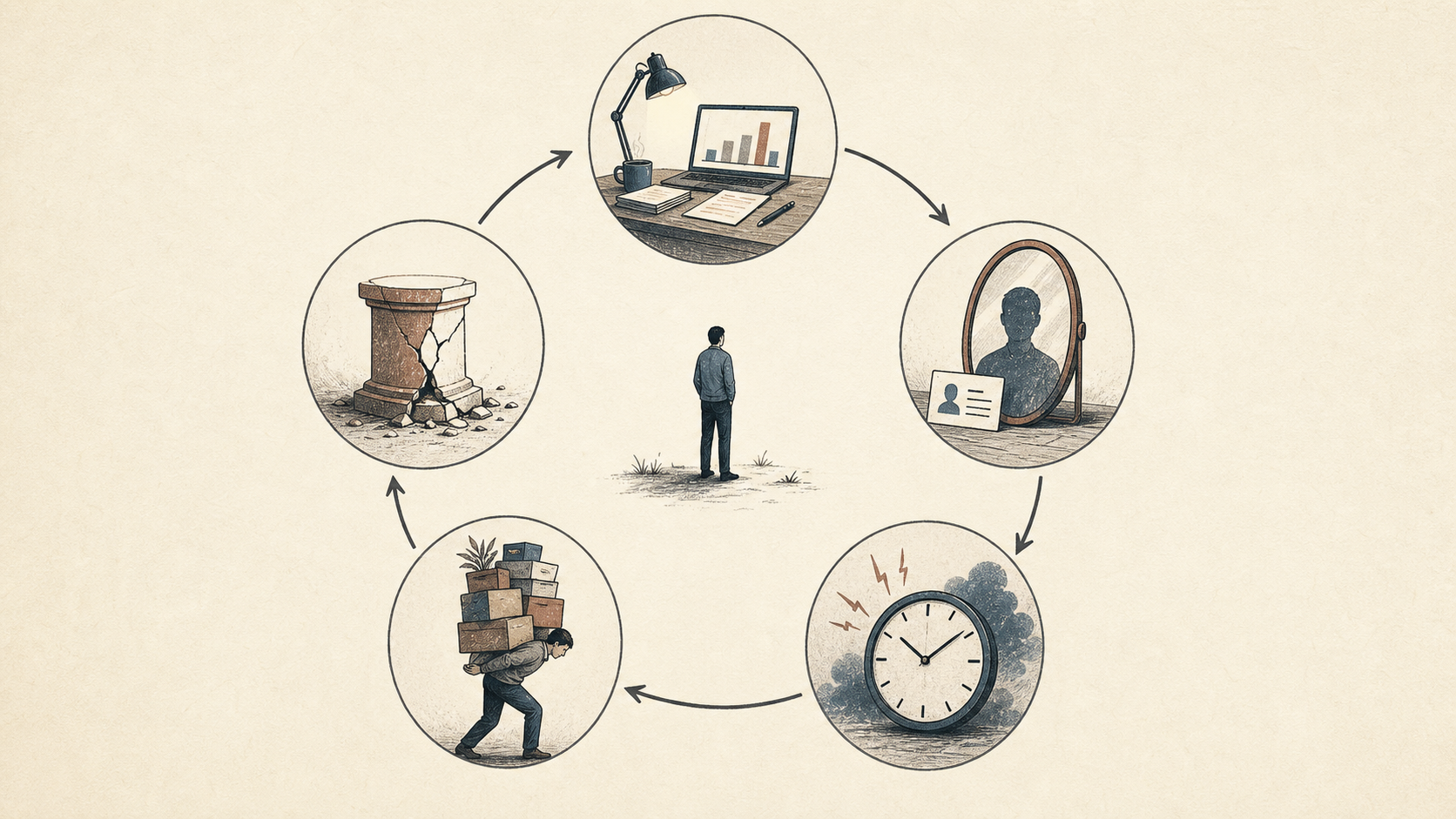
This bargain is especially tempting in fields where the work is genuinely interesting. Research, tech, startups, academia, and creative work are all vulnerable because they offer more than income. They offer curiosity, social recognition, visible progress, and sometimes a feeling of historical participation.
That is part of their beauty. It is also part of their risk.
Intensity is not the problem by itself. Anything difficult and worthwhile will ask for periods of sacrifice. A life with no demanding work can become small in a different way.
The danger begins when temporary sacrifice becomes permanent identity, when limits are treated as weakness, when rest has to justify itself in productivity terms, and when every part of life is reorganized around professional optimization.
At that point, work has stopped being a site of formation. It has become a judge.
Meaningful Work Has Its Own Trap
The jobs most likely to consume people are not always the meaningless ones. Often they are the meaningful ones.
Meaningless work can be exhausting or alienating, but it is less likely to persuade someone that exhaustion is noble. Meaningful work has a subtler power. It can make unhealthy conditions feel morally necessary. It can turn overwork into commitment, underpayment into devotion, and weak boundaries into proof that one really cares.
This is why the language around work matters. Words like mission, passion, family, ownership, calling, and impact can name real goods. They can also hide bad bargains. They can make economic relationships sound sacred. They can make asking for rest, money, credit, or scope feel like a failure of belief.
Ambitious people often participate in this bargain willingly because it offers a flattering identity. It says: you are not merely working hard; you are the kind of person who matters because you work hard.
The emotional reward is real. So is the cost.
The cost is that a person can lose the ability to distinguish caring from disappearing. They may think they are protecting the work while burning the conditions that make good work possible: attention, health, patience, curiosity, relationships, and the capacity to stay honest.
Good work needs energy. It also needs a self that has not been entirely consumed by the work.
The Structural Caveat
There is an obvious limitation in any discussion of the good enough job: not everyone has the same freedom to choose one.
For some people, the problem is not that work has become an identity project. The problem is that work does not pay enough, does not provide health care, does not protect dignity, does not allow schedule control, or does not leave enough energy for anything else. Telling such a person to "diversify meaning" can become insulting if the material conditions of work are destroying the possibility of a wider life.
That caveat matters. The ability to ask whether a job fits one's life is unevenly distributed. Savings, credentials, passports, health, caregiving responsibility, discrimination, local labor markets, and immigration status all change the available choices.
But the caveat does not make the argument irrelevant. It changes where the argument lands.
At the individual level, the good enough job asks people with some agency to stop confusing prestige with fit. At the organizational level, it asks managers and institutions not to exploit devotion as a substitute for humane design. At the political level, it reminds us that a society where work is the main route to health care, dignity, and belonging will naturally produce work-centered lives.
So this cannot be solved only by attitude. Boundaries are easier to keep when they are supported by wages, staffing, leave policies, labor protections, and norms that do not make survival depend on permanent availability.
Still, the core claim remains useful: human worth should not be made identical with productivity. That is not a luxury belief. It is part of what makes exploitative work recognizable as exploitation in the first place.
A Good Enough Job Is Not a Small Ambition
The phrase "good enough job" can sound like resignation if read too quickly. It can seem to mean lowering standards, giving up on excellence, or treating work as a tolerable inconvenience.
I think the stronger reading is almost the opposite.
A good enough job is not a job that does not matter. It is a job that is allowed to matter in proportion. It provides enough money, dignity, challenge, stability, autonomy, and room to live. It supports a life rather than replacing one. It makes serious work possible without keeping the self permanently on trial.
This is not anti-ambition. It is a better container for ambition.
Without a concept of enough, ambition becomes endless by default. There is always a better institution, a more visible project, a higher salary, a stronger title, a faster trajectory, a more impressive peer group. If external comparison defines the target, the target will keep moving.
Enough is not laziness. It is a design constraint.
It asks a prior question before career optimization begins: what kind of life is this work supposed to serve?
Not in the abstract. Concretely. What must remain protected? What kind of attention do I need? Which relationships do I not want to neglect? Which rhythms keep me capable of doing work I respect? Which forms of success would make my life look better from the outside and worse from the inside?
These questions are practical. A career that looks impressive but destroys the conditions for judgment, health, and sustained contribution is not necessarily a better career. It may only be a more socially legible form of failure.
Designing Around Enough
One way to make "enough" more than a comforting word is to separate career desire into dimensions.
Money, autonomy, learning, reputation, location, schedule, colleagues, mission, craft, stability, upside, and health are not the same thing. A job can be better on one dimension and worse on another. Much career confusion comes from treating the most visible dimension as the total score.
Prestige is especially distorting because it compresses many uncertainties into one social signal. It tells other people how to rank the choice before one has asked whether the choice fits the life.
Enough requires doing the opposite. It makes the hidden tradeoffs explicit.

The useful questions are often plain:
- What would I accept less of in exchange for more time?
- What would I accept less visibility for in exchange for deeper craft?
- What salary is actually enough for this stage of life?
- Which forms of intensity make me better, and which ones only make me more available?
- Which ambition still feels like mine when no one is watching?
These questions are uncomfortable because they remove the protection of obvious answers. It is easier to say "I want the best job" than to define what "best" means. It is easier to follow a ranking than to admit that one's life has needs and loyalties that do not map cleanly onto prestige.
But this is exactly why the questions matter. A good enough job is not found by lowering the standard. It is found by using a more honest one.
Devotion Is Not Dependence
One difficulty is that devotion and dependence can look similar from the outside.
Both may involve long hours, intense focus, high standards, and a willingness to endure frustration. Both may produce excellent work. From the outside, the devoted person and the dependent person may look equally serious.
The difference appears when work fails.
Devotion can survive failure because the self is larger than the outcome. A rejected paper hurts, but it does not annihilate the person. A failed product teaches something, even if it costs time and pride. A lost opportunity disappoints, but it does not prove that life has no shape.
Dependence cannot do this as easily. When work is the main source of identity, failure becomes ontological. The person does not merely think, "This did not work." They think, "I did not work." The boundary between output and self collapses. Recovery becomes harder because there is nowhere outside work from which to recover.
That is why a wider life is not a sign of weaker commitment. It is what allows commitment to remain sane. People who have relationships, practices, and meanings outside work are not necessarily less serious. They may be more able to return to the work without desperation.
Desperation can produce energy. It rarely produces good judgment for long.
The Particular Risk for Researchers and Builders
This problem feels sharp for people who build, research, or create.
In these worlds, work is not only labor. It is curiosity, taste, identity, and social belonging at once. A good research problem can occupy the mind beautifully. A system can become an object of care. A field can feel historically alive. A community can make professional belonging feel like personal belonging.
Again, that is part of the beauty of the work. It is also part of the danger.
Researchers can start treating acceptance decisions as judgments of personal legitimacy. Builders can treat velocity as evidence of seriousness. Founders can treat exhaustion as proof of belief. Students can treat institutional approval as the line between being real and being exposed. In fast-moving fields, the fear of falling behind can become permanent weather.
The answer is not to stop caring. A detached relationship to meaningful work is not obviously healthier. The better answer is to preserve the part of work that deserves devotion while refusing the part that demands worship.
Do the work. Take it seriously. Improve your taste. Build things that are useful. Ask better questions. Accept periods of intensity when they are genuinely necessary.
But keep some part of the self outside the institution, outside the benchmark, outside the review cycle, outside the market, and outside the feed. Otherwise work will no longer be something you do with your life. It will become the system that tells you whether you are allowed to have one.
A Better Measure of Work
Maybe the right question is not whether work should be central or peripheral. That still treats life like a pie chart.
A better question is what work does to the rest of life.
Does it make a person more capable, honest, attentive, generous, and grounded? Does it build skill without hollowing out the self? Does it give structure without becoming a cage? Does it create responsibility without turning every outcome into a verdict? Does it leave enough room for recovery, love, friendship, and forms of meaning that do not need professional justification?
If yes, work is doing something important.
If no, even impressive work may be badly arranged.
This is the part of Stolzoff's argument that feels most useful to me. The goal is not to dethrone work because work is fake. The goal is to put work back into relation with the rest of life because work is real. It is too important to be treated as an idol, and too limited to be treated as a complete philosophy of living.
Work should form us, but not consume us. It should challenge us, but not become the only court of judgment. It should give us a place to practice seriousness, but not convince us that seriousness exists only there.
The good enough job, then, is not an argument for a good enough life. It is almost the reverse. It is an argument for a life large enough that work can be meaningful without becoming sovereign.
That may be the more durable ambition: not to make work smaller, but to make life larger than work again.
FAQ
Is this an anti-work argument?
No. Work can be one of the main ways people develop skill, discipline, judgment, and contribution. The concern is not work's importance, but its totalization.
What does a good enough job mean?
A good enough job is a job that provides enough money, dignity, challenge, stability, autonomy, and room to live. It does not mean a mediocre job. It means work that supports a life rather than replaces one.
Can ambitious people still accept this view?
Yes. The point is not to abandon ambition, but to place ambition inside a wider human architecture. Ambition becomes more durable when it is not driven by identity panic.
Why is meaningful work sometimes more dangerous than meaningless work?
Meaningful work can make sacrifice feel morally required. When people believe deeply in a mission, craft, field, or institution, they may accept exhaustion, underpayment, weak boundaries, or constant availability because the work feels too important to question.
What is the practical test for whether work is well arranged?
Ask what work does to the rest of life. Does it make a person more capable, honest, attentive, and grounded, or does it hollow out the self while looking impressive from the outside?
Citation
Please cite this article as:
Ji, Wenbo. “Work Is Important Enough Not to Become Everything”. fusheng-ji.github.io (May 2026). https://fusheng-ji.github.io/blog/posts/why-work-matters-but-should-not-be-everything/
Or use the BibTeX entry:
@article{ji2026whyworkmattersbutshouldnotbeeverything,
  title = {Work Is Important Enough Not to Become Everything},
  author = {Ji, Wenbo},
  journal = {fusheng-ji.github.io},
  year = {2026},
  month = {May},
  url = {https://fusheng-ji.github.io/blog/posts/why-work-matters-but-should-not-be-everything/}
}
References and Further Reading
-
Simone Stolzoff. The Good Enough Job: Reclaiming Life from Work. The book that prompted this essay.
-
Derek Thompson. "Workism Is Making Americans Miserable." The Atlantic. A useful framing of work as identity, purpose, and quasi-religious meaning.
-
World Health Organization. "Burn-out an occupational phenomenon: International Classification of Diseases." Helpful for distinguishing workplace burnout as an occupational phenomenon rather than a complete philosophy of personal failure.
-
Kathi Weeks. The Problem with Work: Feminism, Marxism, Antiwork Politics, and Postwork Imaginaries. A more political critique of the assumption that waged labor is inherently a social good.
-
Robert Skidelsky and Edward Skidelsky. How Much Is Enough? Money and the Good Life. A related argument about sufficiency, ambition, and the good life.
Note: This blog was drafted and polished with the assistance of ChatGPT (GPT-5.4 Thinking), based on my reading notes on Simone Stolzoff's The Good Enough Job. Illustrations were generated with GPT Image 2.