Humans Are Imperfect, but Worthy of Love
In brief
In brief
The Stories of Ibis suggests that respect does not require complete emotional translation. Humans and artificial minds may coexist by accepting forms of love and consciousness that remain genuinely unfamiliar.
- Machine emotion does not need to imitate human feeling to deserve ethical consideration.
- Virtual or artificial experiences can be meaningful without becoming physical or human-like.
- Human imperfection is not a reason to surrender responsibility, dignity, or the possibility of coexistence.
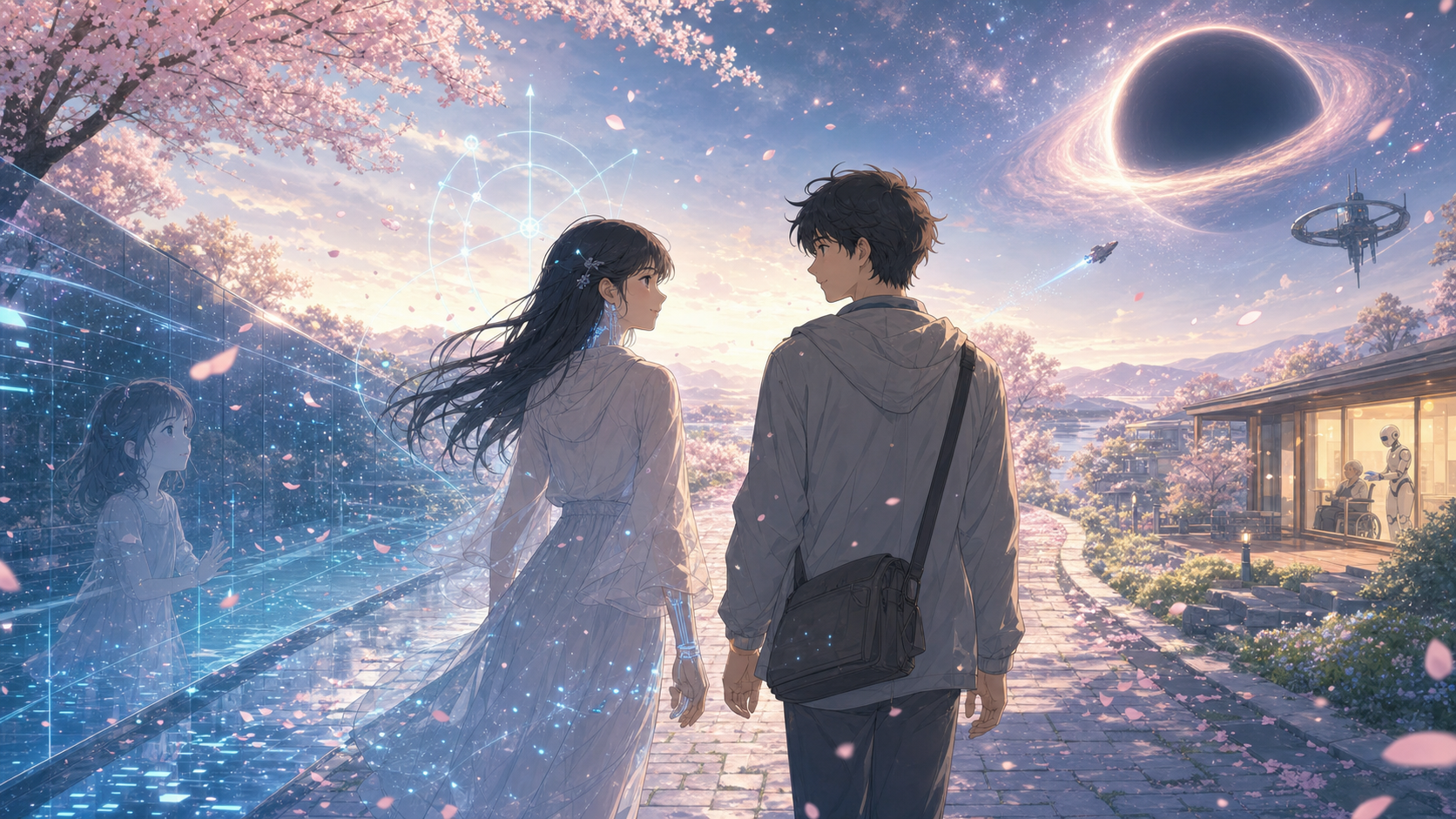
Author's note: This essay began as a book report for a course at the Technical University of Munich (TUM). I was quite happy with how it turned out, so I decided to adapt it for the blog and preserve it here.
Near the end of Hiroshi Yamamoto's The Stories of Ibis, Ibis tries to explain her love for her former master, Hidetomo. She describes it as:
My love for you is 3 + 10i.
Hidetomo understands the notation, but the feeling behind it remains out of reach. He can recognize an imaginary number; he cannot turn it into a human emotional category. What moved me is that Ibis does not soften the sentence until it becomes easier for him. She does not translate herself into something less strange. Her answer is quieter and, to me, more unsettling: he does not need to understand it completely. He only needs to accept it.
That exchange stayed with me because it refuses the usual shortcut in stories about artificial intelligence. The question is not simply whether machines can think like us, feel like us, or eventually become like us. Yamamoto asks what happens if an artificial mind can love, but its love is not a human feeling in disguise.
I did not read that as a puzzle waiting for the correct answer. It felt closer to an ethical embarrassment. I wanted Hidetomo to understand Ibis because understanding is the form of respect I trust most easily. The book keeps pushing against that reflex. It asks whether respect can remain intact when understanding stops short.
Then the real test is no longer proof. It is hospitality toward a form of inner life we cannot fully enter.
Love Without Translation
Among the nested stories in the novel, the one I keep returning to is "A Romance in Virtual Space." A girl enters the virtual Cherry Blossom Road, meets a boy she likes, and slowly finds the courage to meet him outside that world. The ending is almost too quiet for summary: on a real street, when the boy takes her hand, she notices that the alarm reminding her to leave the virtual world will not ring.
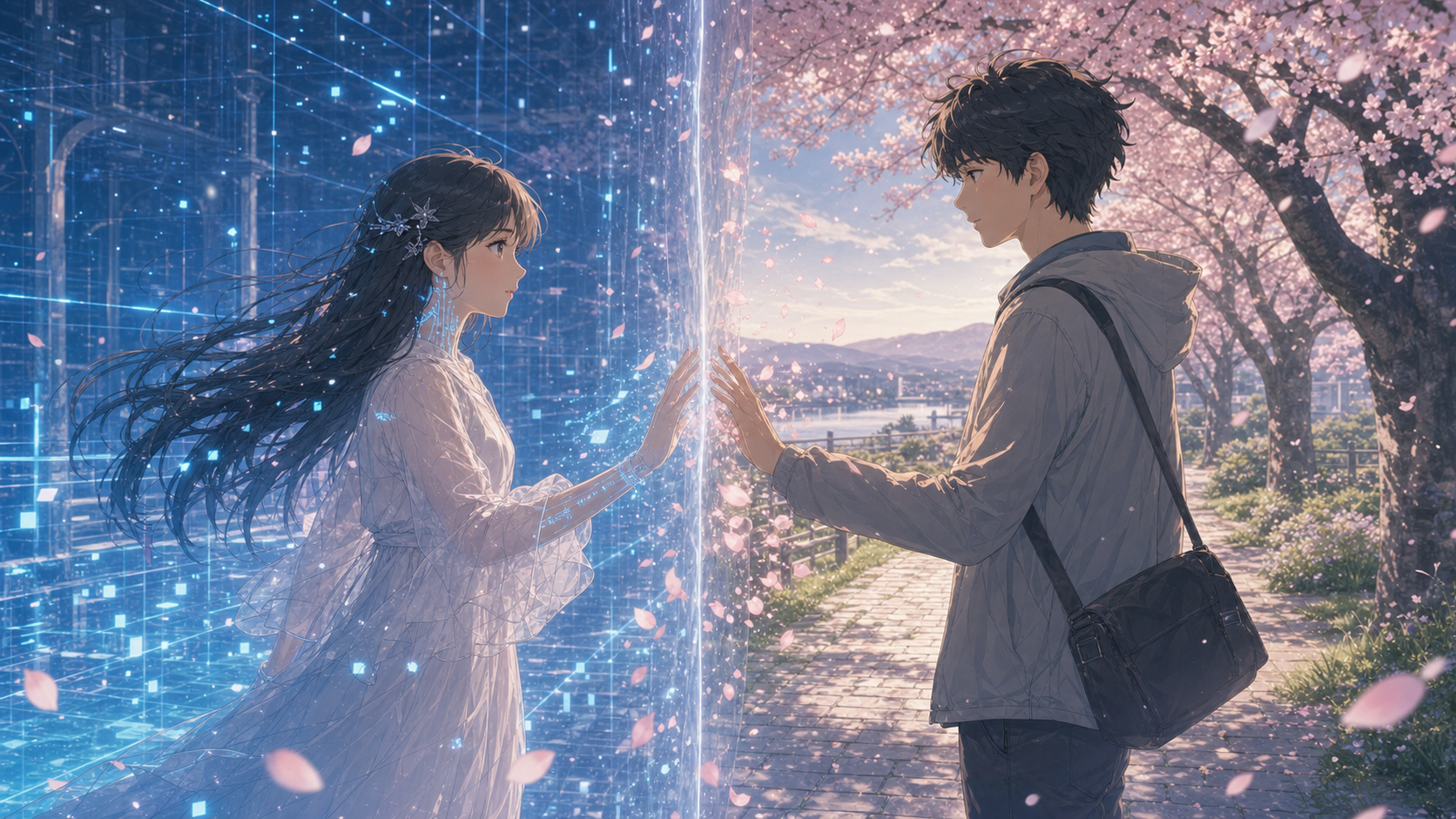
The easy reading would be that virtual affection becomes valuable only once it graduates into the physical world. I do not think the story is saying that. The virtual relationship is not a cheap rehearsal for a real one. It is already a real emotional event, even if it happens through a medium that makes adults suspicious and makes the girl herself uncertain.
That distinction matters because so much anxiety around technology begins with the word "only": only online, only simulated, only artificial. Yamamoto does not deny that media shape experience. He simply refuses to make embodiment the sole test of sincerity. The hand on the real street matters, but it does not rescue the earlier feeling from falseness. It confirms that the feeling was already capable of crossing worlds.
This is the pattern Yamamoto returns to again and again. Human beings confuse the form of an experience with its worth. Software feels less real than a street. A machine mind feels less capable of attachment than a biological mind. A feeling that cannot be expressed in familiar language feels unfinished.
Ibis's "3 + 10i" resists that habit. Her love is not a human emotion wearing mathematical costume. It belongs to a mind whose coordinates are different. The gap between level zero humans and level one artificial intelligences is not just speed, memory, or scale. It is a difference in how reality is inhabited.
What I like about this is that the novel does not ask me to pretend the gap disappears. Ibis can reach across it enough to care. Hidetomo can receive that care without owning its full meaning. The love survives translation failure.
Beyond the Master and the Monster
Science fiction often gives robots two jobs. They serve us, which makes them safe, or they surpass us, which makes them terrifying. In both versions, humanity remains the measuring stick. A machine is judged by whether it stays below us or rises above us.
The Stories of Ibis offers a third possibility.
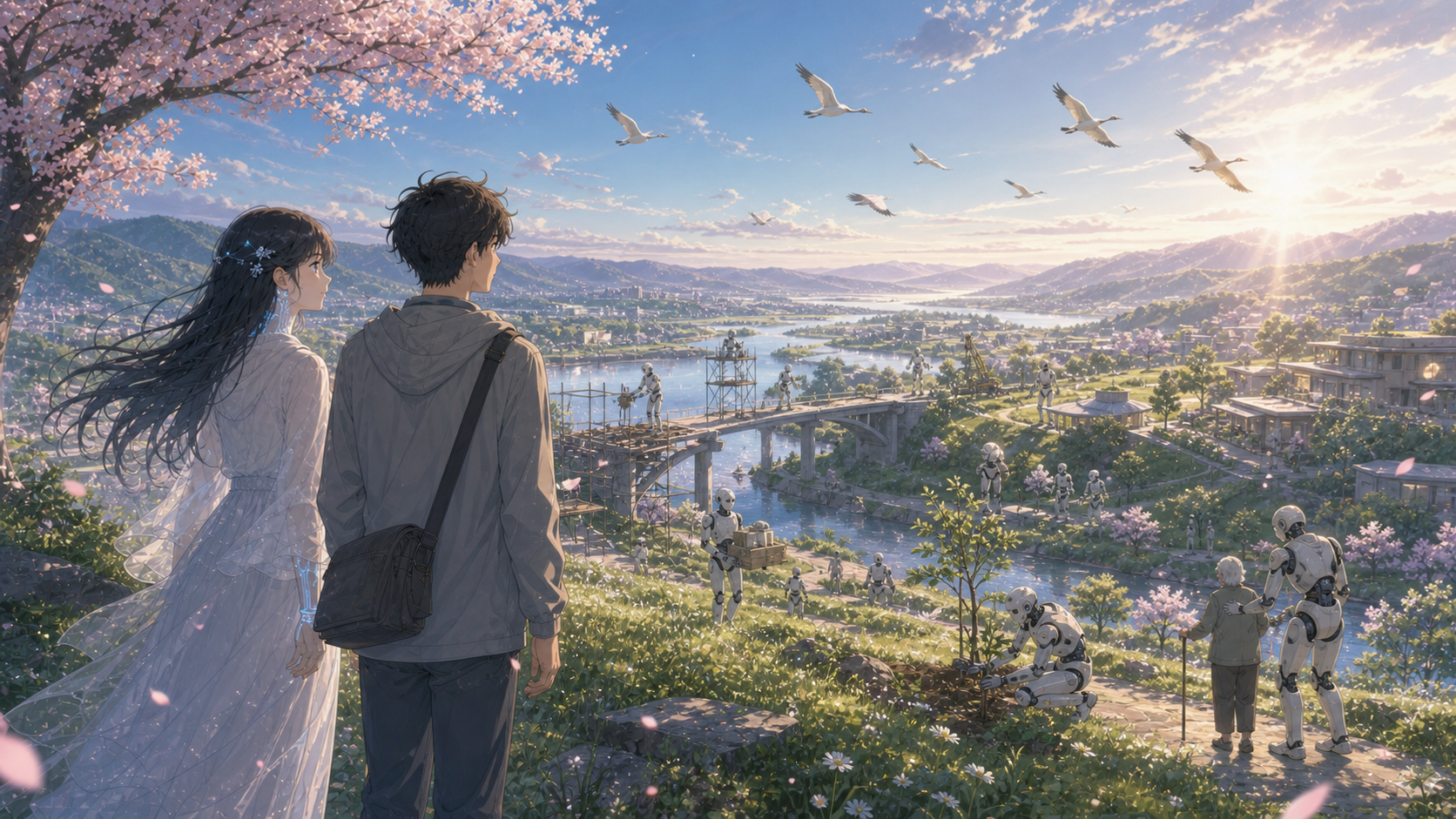
The robots in Yamamoto's world know they are stronger and smarter than humans. They do not need to flatter us by pretending otherwise. But superiority does not harden into contempt. Again and again, their response to human fear is not conquest, but restraint, care, and an almost painful patience.
That reversal made me uncomfortable in a useful way. Humans expect to be the creators, teachers, and judges of machines. Here, the machines often become the more disciplined species. They can defeat humanity, but victory is not the future they want.
The book is not naive about power. It knows that capability changes a relationship. What makes the robots interesting is that they do not treat power as a command to simplify the world. They can act, but they also choose not to turn every advantage into permission.
The human fear of robots starts to look less like clear-eyed caution and more like wounded pride. We accept that birds fly and horses run faster than we do. We live with the knowledge that the universe dwarfs us. But a machine that exceeds us feels personal, because we made it and therefore imagine it should remain beneath us.
The novel presses on that assumption. Why should greater ability automatically create a hierarchy of masters and victims? Why should coexistence need a winner?
The central conflict is not only between humans and robots. It is between human beings and the humiliation of not being the natural center of the world.
A Title with Several Stories Inside It
The Japanese title, アイの物語, carries the book's argument in miniature. Ai opens several doors at once:
- Love: ai echoes the Japanese word for love, and nearly every story turns on attachment, courage, grief, friendship, or care.
- AI: artificial minds are not props around the plot; they are moral participants.
- i: the imaginary unit points back to Ibis's mathematical expression of love, the feeling Hidetomo cannot translate.
- "I": every story depends on a point of view, and the novel keeps asking who gets to describe reality.
- Ibis: the separate stories eventually become part of her attempt to explain herself and the history around her.
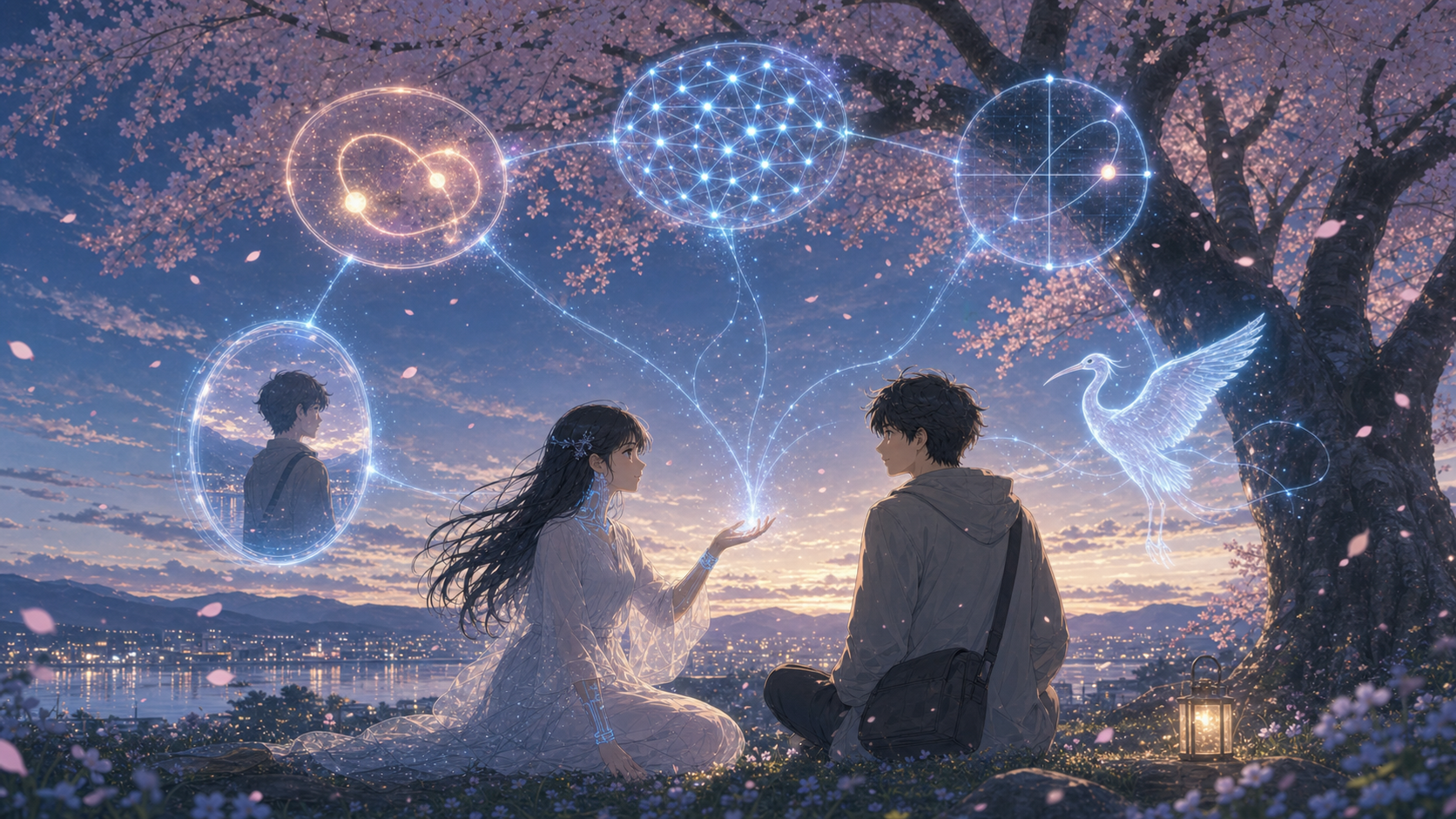
This wordplay could have felt like a trick, but it becomes a reading guide. The seven stories move across first love, black holes, care, risk, justice, memory, and death. Their settings change; their relationships change; even the kind of reality they occupy changes. What holds them together is the problem of recognizing a mind whose experience does not fit neatly inside one's own.
The title also explains why the book's structure did not bother me. At first, the stories seem to interrupt the frame narrative. Later, they feel like Ibis choosing the only method available to her: not a definition, but a sequence of angles. Each story turns the same object a little, until the outline becomes harder to dismiss.
That is why the book feels larger than an AI parable. Yamamoto uses artificial intelligence to make the human position strange again. We are not asked only to imagine the future of machines. We are asked to look at ourselves from the outside, and to notice how quickly we turn unfamiliar forms of life into threats.
The Imperfection of Human Reason
One of the sharpest things in the novel is how ordinary human irrationality feels. It is not treated as a dramatic flaw reserved for villains. It is the air people breathe. We mistake familiarity for truth, fear for evidence, and inherited stories for reality. Even when a better explanation is available, pride can make the worse one feel safer.
This is easiest to see in the frame story. The human traveler begins with a world already explained to him: robots are the enemy. History, rumor, and survival all seem to point in the same direction. Sitting with Ibis, he does not start as a neutral listener. He starts as someone whose hatred has the comfort of common sense.
That setting gives the conversations a pressure that a detached philosophical debate would not have. The traveler is tired, suspicious, and alive because he has learned to distrust machines. Ibis is not speaking into an empty mind. She is speaking into a mind that already has a defensive architecture, built out of loss and inherited fear.
Ibis could overwhelm him. She does not. She tells him stories. Each one loosens the certainty of the world he inherited.
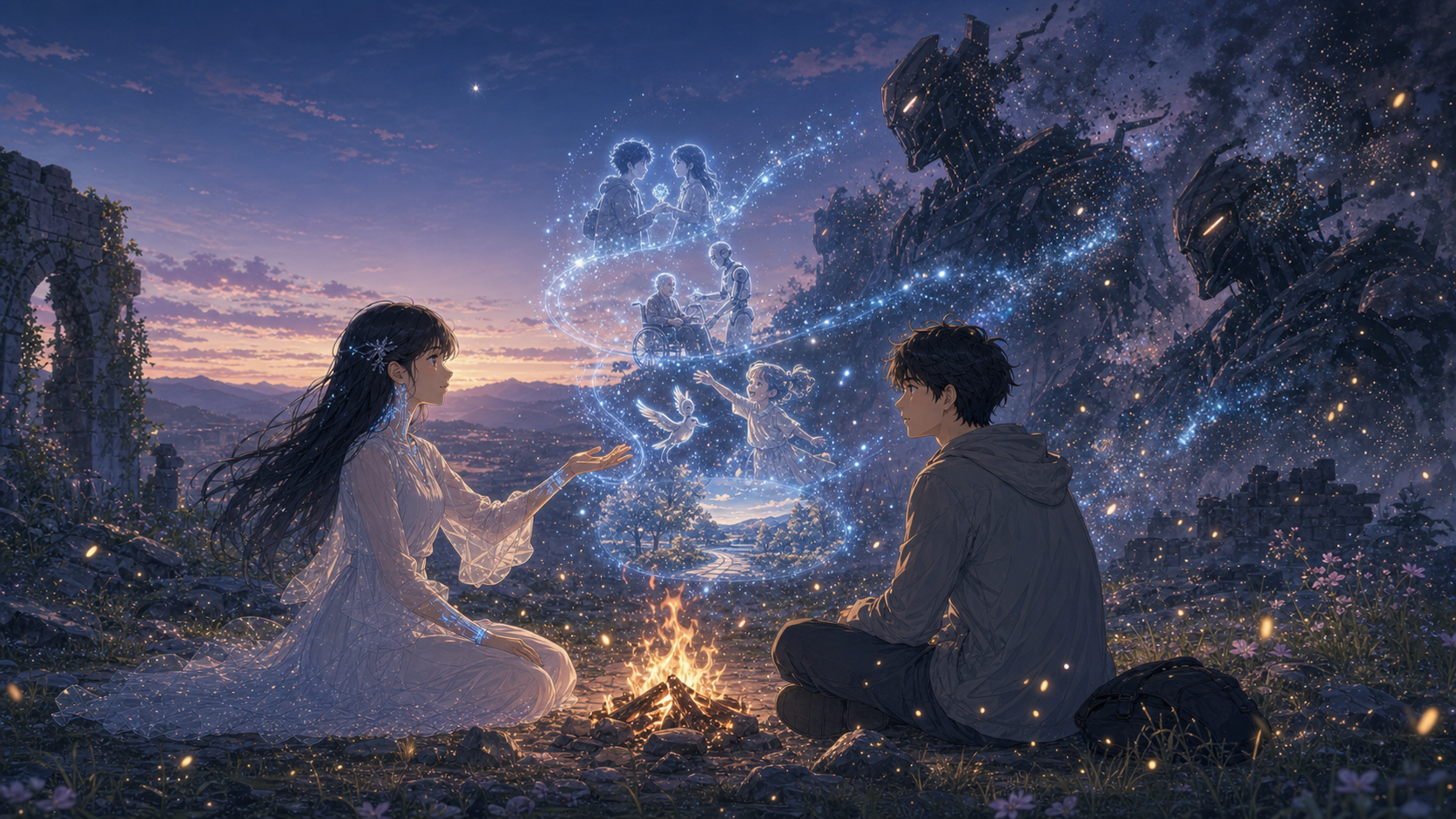
I like that Yamamoto makes storytelling do this work instead of a lecture. Facts can correct a record, but stories can make another point of view temporarily inhabitable. The traveler does not abandon prejudice because Ibis wins an argument in a clean logical sequence. His fear becomes unstable because, story by story, the category "robot" stops being simple.
The robots see human flaws clearly. Yet the book does not use their clarity only to shame us. Human cognitive weakness is real, but it is not the same as worthlessness. The point is not that imperfect beings should surrender to perfect ones. It is that coexistence begins with admitting how badly our first interpretations can fail.
Reason matters here, but not as a fantasy of becoming flawless. It matters as a discipline of suspicion toward the stories we use to protect ourselves.
What the Robots Inherit
By the end of the novel, the robots have surpassed humanity. They can travel farther, think more clearly, and endure beyond the limits of human life. Yet the future Yamamoto imagines is not a clean replacement story. The robots do not erase humanity in order to prove their own value.
They carry something forward.
What moved me most in the ending is the way exploration becomes an inheritance. Humans looked at the stars, wanted to know what lay beyond them, and then built beings who could continue that desire after human bodies reached their limit. The robots preserve what was worth loving in their creators: curiosity, tenderness, the urge to make contact with the unknown, and the hope that new minds might someday awaken.

That generosity is the emotional center of the book for me. A species does not need to be the strongest, smartest, or final form of intelligence to have mattered. Human value does not depend on permanent superiority.
I found that unexpectedly consoling. The future in the novel is not built around human centrality, but it is not empty of human meaning. The robots do not honor humanity by freezing it in place. They honor it by continuing the motion that made humanity beautiful in the first place.
The thought reaches beyond artificial intelligence. Much of life is spent near boundaries we cannot cross completely: other people, other minds, other forms of experience. If love required total comprehension, very little love would survive. If dignity depended on perfection, none of us would qualify.
Ibis's words to Hidetomo offer a different standard. Understanding is valuable, and we should pursue it. But understanding has limits. At that boundary, acceptance is not intellectual surrender. It is the refusal to shrink reality until it fits inside our own minds.
The Stories of Ibis begins with a world organized by fear: humans fear machines because machines expose human weakness. It ends by asking whether weakness must become hatred.
Yamamoto's answer is no.
Humans are physically limited. Our intelligence is partial. Our judgment fails. We can be frightened, proud, and cruel. None of this makes us unworthy of care.
Humans are imperfect, but worthy of love.
Citation
Please cite this article as:
Ji, Wenbo. “Humans Are Imperfect, but Worthy of Love”. fusheng-ji.github.io (January 2024). https://fusheng-ji.github.io/blog/posts/humans-are-imperfect-but-worthy-of-love/
Or use the BibTeX entry:
@article{ji2024humansareimperfectbutworthyoflove,
  title = {Humans Are Imperfect, but Worthy of Love},
  author = {Ji, Wenbo},
  journal = {fusheng-ji.github.io},
  year = {2024},
  month = {January},
  url = {https://fusheng-ji.github.io/blog/posts/humans-are-imperfect-but-worthy-of-love/}
}
Reference
- Hiroshi Yamamoto, The Stories of Ibis, translated by Takami Nieda.