ViDS: Video Diffusion Shader using 3D Face Tracking
Abstract
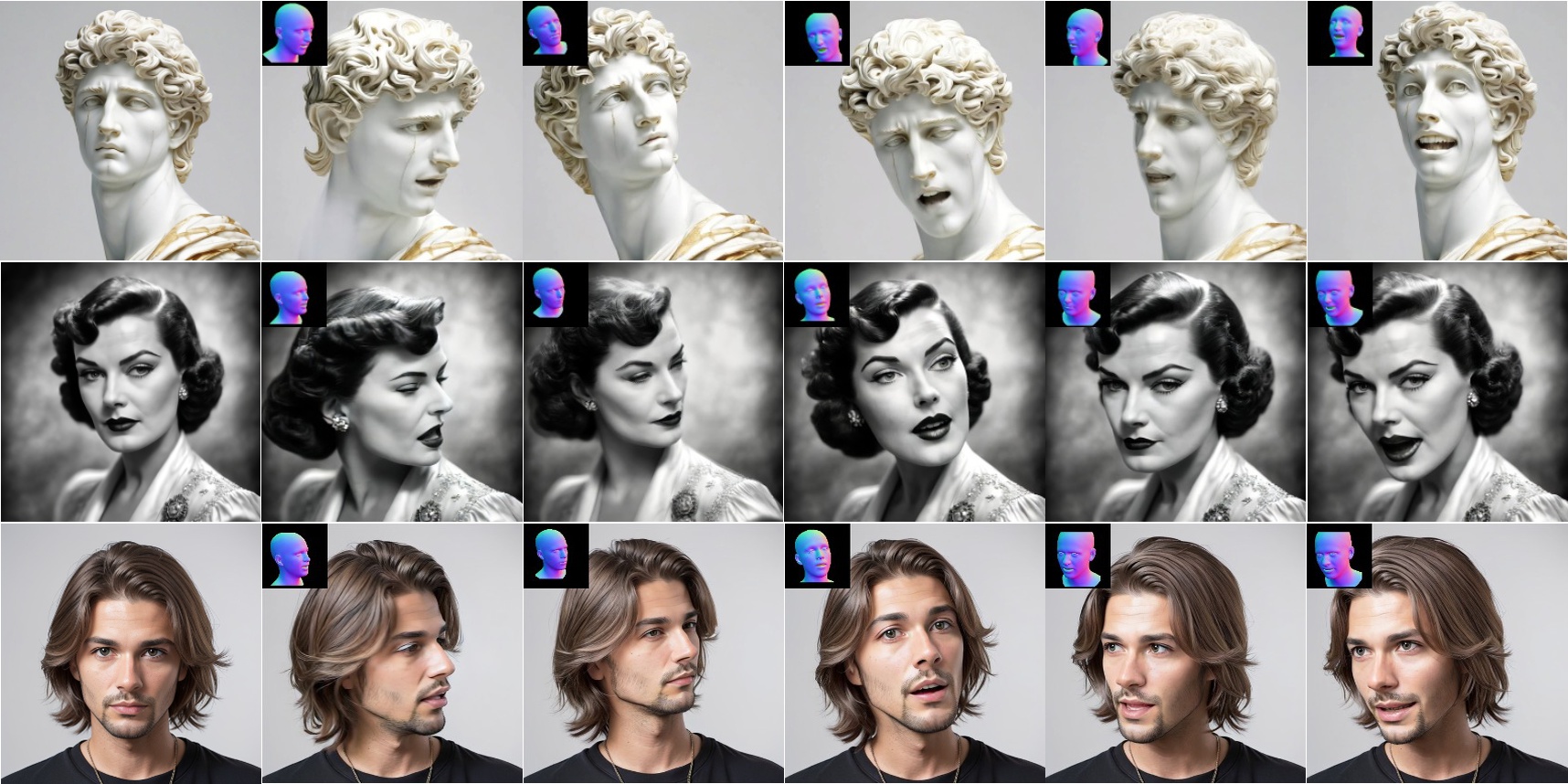
We introduce ViDS, a Video Diffusion Shader that leverages 3D face tracking for expressive and identity-preserving portrait animation. We first reconstruct the identity-specific 3DMM mesh from the reference image, and then animate it using expression and pose parameters from a driving video. Leveraging dense geometric cues from 3DMM normal maps, we employ a video diffusion model as a neural shader to synthesize lifelike portrait animations while preserving the appearance and identity of the reference image. We find that more accurate 3DMM tracking enables finer-grained expression control. We also introduce an autoregressive diffusion sampling process that extends generation beyond the model's native window while reducing discontinuities between adjacent clips.
Compared with prior diffusion-based approaches for portrait animation that rely on landmark-based conditioning or implicit motion latents, our method achieves more detailed and consistent expression and pose control while faithfully preserving identity and appearance. Detailed ablation studies validate the effectiveness of our design choices.
Method Overview
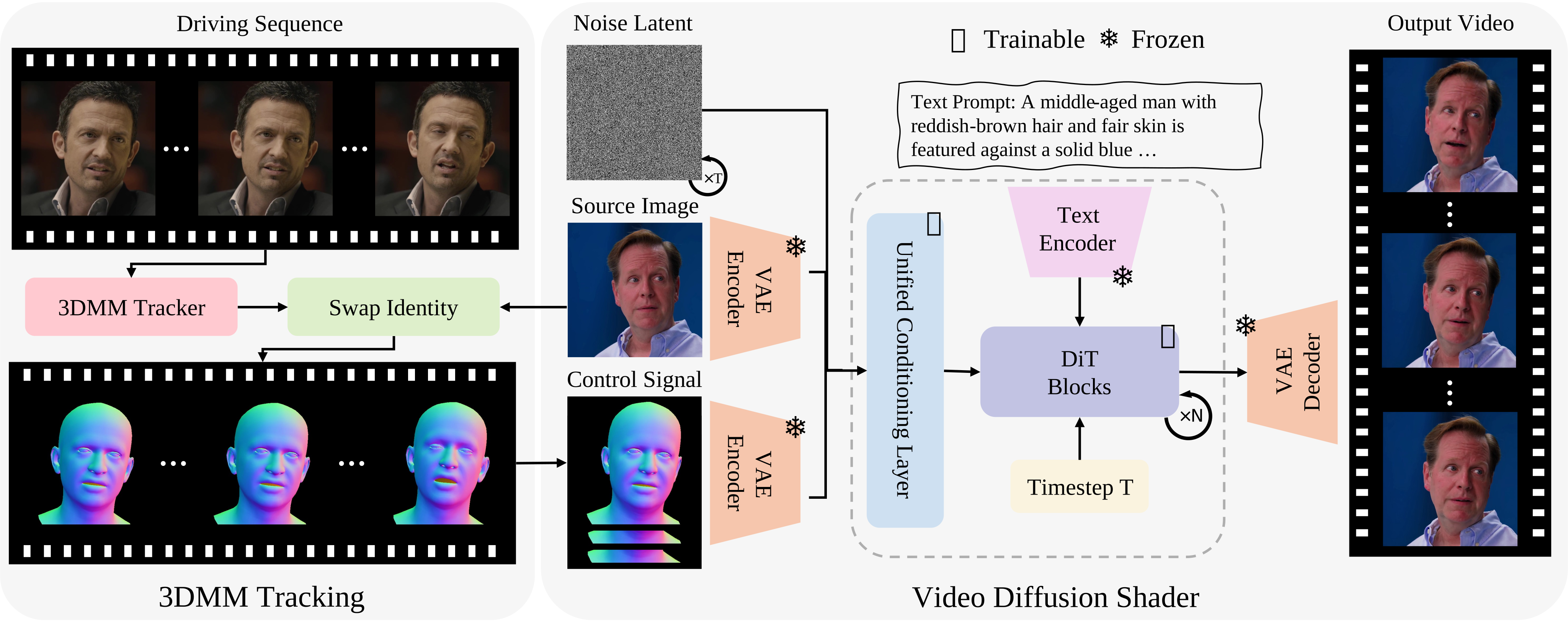
ViDS conditions generation on a source image, a sequence of Pixel3DMM normal maps, and a text prompt generated from the driving video by a vision-language model. The reference identity shape is estimated once and kept fixed while pose and expression parameters are transferred from the driving sequence. The resulting normal maps provide dense, pixel-aligned, and lighting-agnostic geometric guidance.
The source image, control sequence, and noise latents are VAE-encoded and combined through a unified conditioning layer before entering the DiT backbone. For long videos, overlapping sliding windows reuse the same reference embedding, fix a latent prefix from the preceding window, and blend overlapping decoded frames to improve identity and temporal consistency.
Qualitative Results
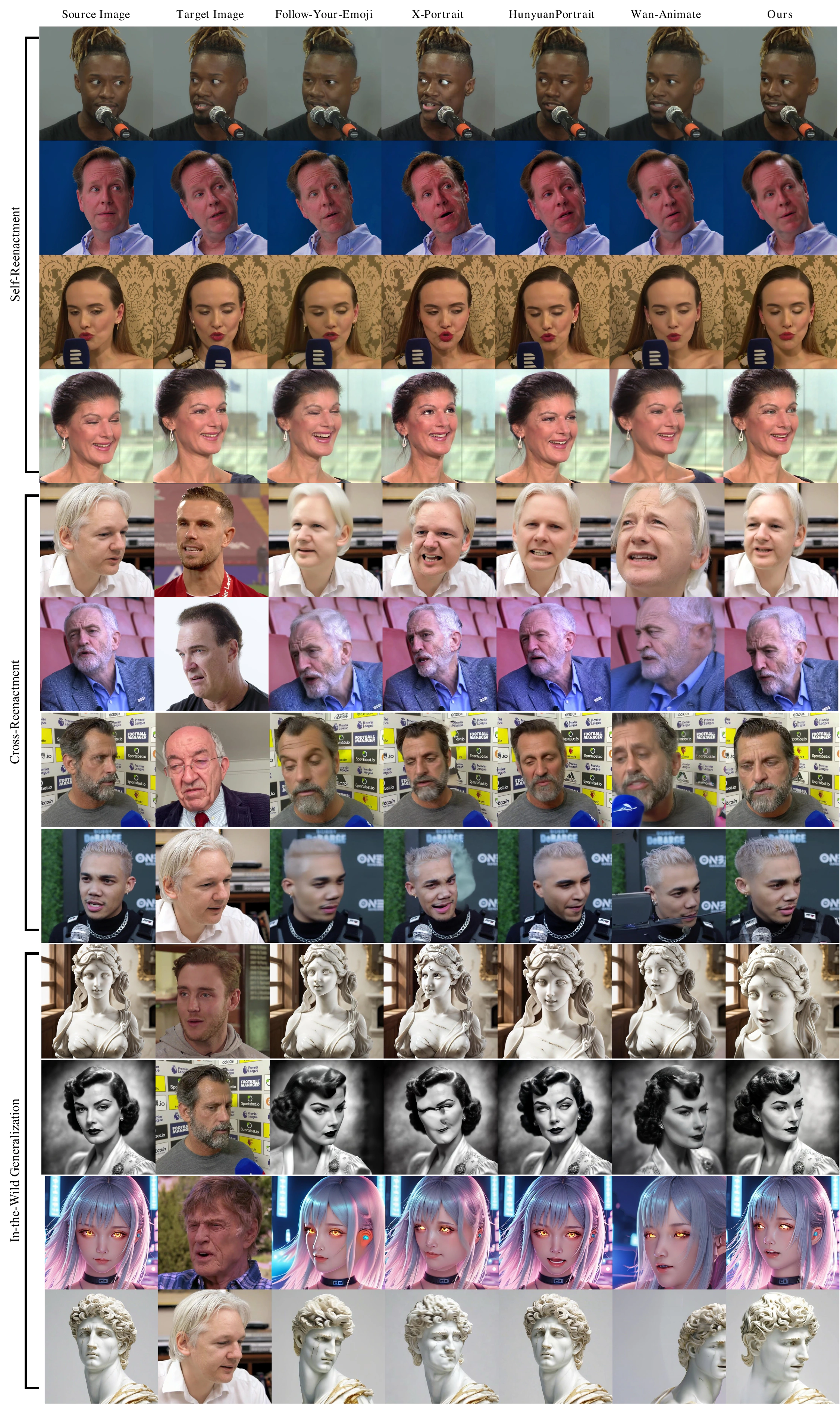
We compare ViDS with Follow-Your-Emoji, X-Portrait, HunyuanPortrait, and Wan-Animate across self-reenactment, cross-reenactment, and zero-shot in-the-wild generalization. ViDS handles challenging expressions and large head-pose changes while preserving source identity and appearance. On the VFHQ test set, ViDS achieves the best self-reenactment SSIM, LPIPS, PSNR, CSIM, AKD, and FID, together with the best cross-reenactment CSIM and APD.
Generation Beyond 3DMM Regions
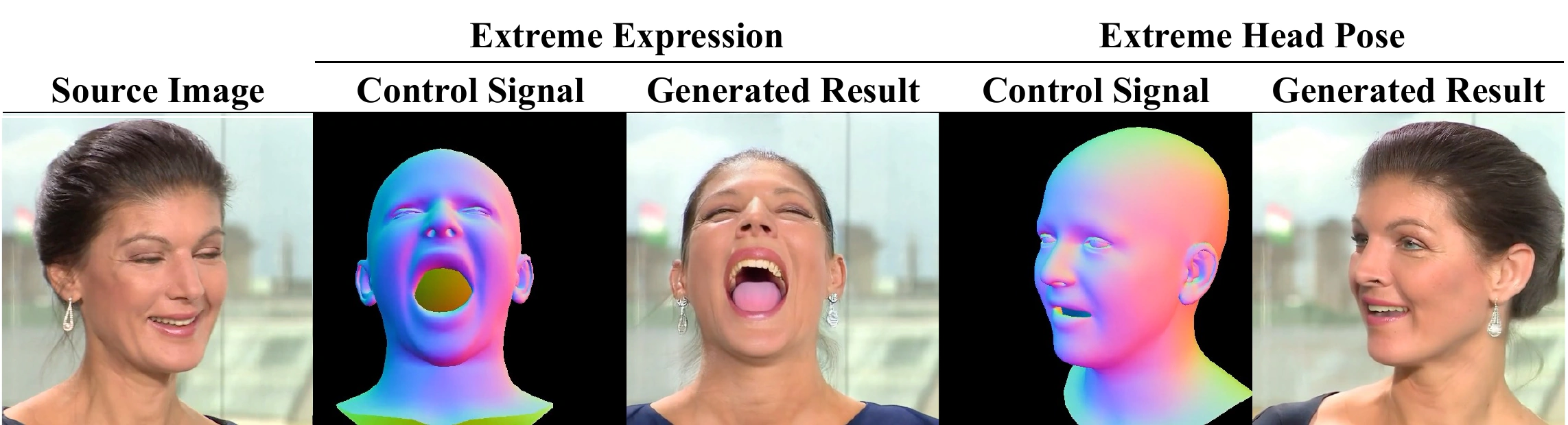
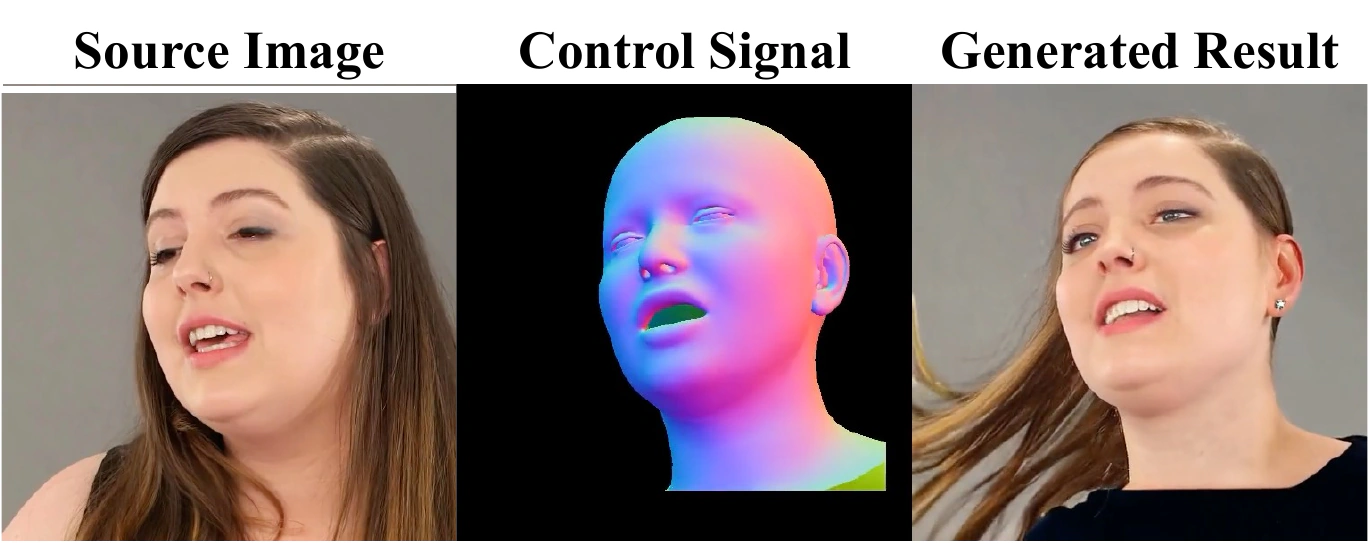
Although the 3DMM supplies structural guidance only for the face, the diffusion shader synthesizes non-parametric details such as teeth, tongue, and hair. Text prompts complement the geometric condition when the requested motion extends beyond the tracked mesh.
Quantitative Results
On the VFHQ test set, ViDS leads most reconstruction, identity, motion, and perceptual metrics. In self-reenactment, it achieves the best SSIM, LPIPS, PSNR, CSIM, AKD, and FID. In cross-reenactment, it obtains the best CSIM and APD while remaining competitive in perceptual quality.
| Method | Self-Reenactment | Cross-Reenactment | |||||||||||
|---|---|---|---|---|---|---|---|---|---|---|---|---|---|
| SSIM ↑ | LPIPS ↓ | PSNR ↑ | CSIM ↑ | AED ↓ | APD ↓ | AKD ↓ | FID ↓ | FVD ↓ | CSIM ↑ | AED ↓ | APD ↓ | IQA ↑ | |
| Follow-Your-Emoji | 0.691 | 0.209 | 20.25 | 0.833 | 0.157 | 0.036 | 4.008 | 22.55 | 0.016 | 0.366 | 0.305 | 0.053 | 59.34 |
| X-Portrait | 0.683 | 0.227 | 19.46 | 0.853 | 0.118 | 0.031 | 3.134 | 24.10 | 0.031 | 0.311 | 0.285 | 0.079 | 58.97 |
| HunyuanPortrait | 0.622 | 0.309 | 17.54 | 0.673 | 0.113 | 0.043 | 17.47 | 26.20 | 0.018 | 0.252 | 0.279 | 0.080 | 56.74 |
| Wan-Animate | 0.713 | 0.187 | 21.13 | 0.876 | 0.118 | 0.017 | 2.775 | 24.01 | 0.013 | 0.227 | 0.286 | 0.053 | 64.51 |
| Ours | 0.722 | 0.178 | 21.19 | 0.879 | 0.121 | 0.022 | 2.752 | 21.29 | 0.020 | 0.372 | 0.298 | 0.049 | 62.85 |
Best results are bold; second-best results are underlined. Rankings use unrounded values. Swipe horizontally to view all metrics.
Comparisons Versus Baselines
Self Reenactment (VFHQ Test Set)
Cross Reenactment (VFHQ Test Set)
In-the-wild Generalization (Human-like Synthetic Characters)
In-the-wild Generalization (Stylized Synthetic Characters)
Ablation Studies
Types of Conditioning Signals
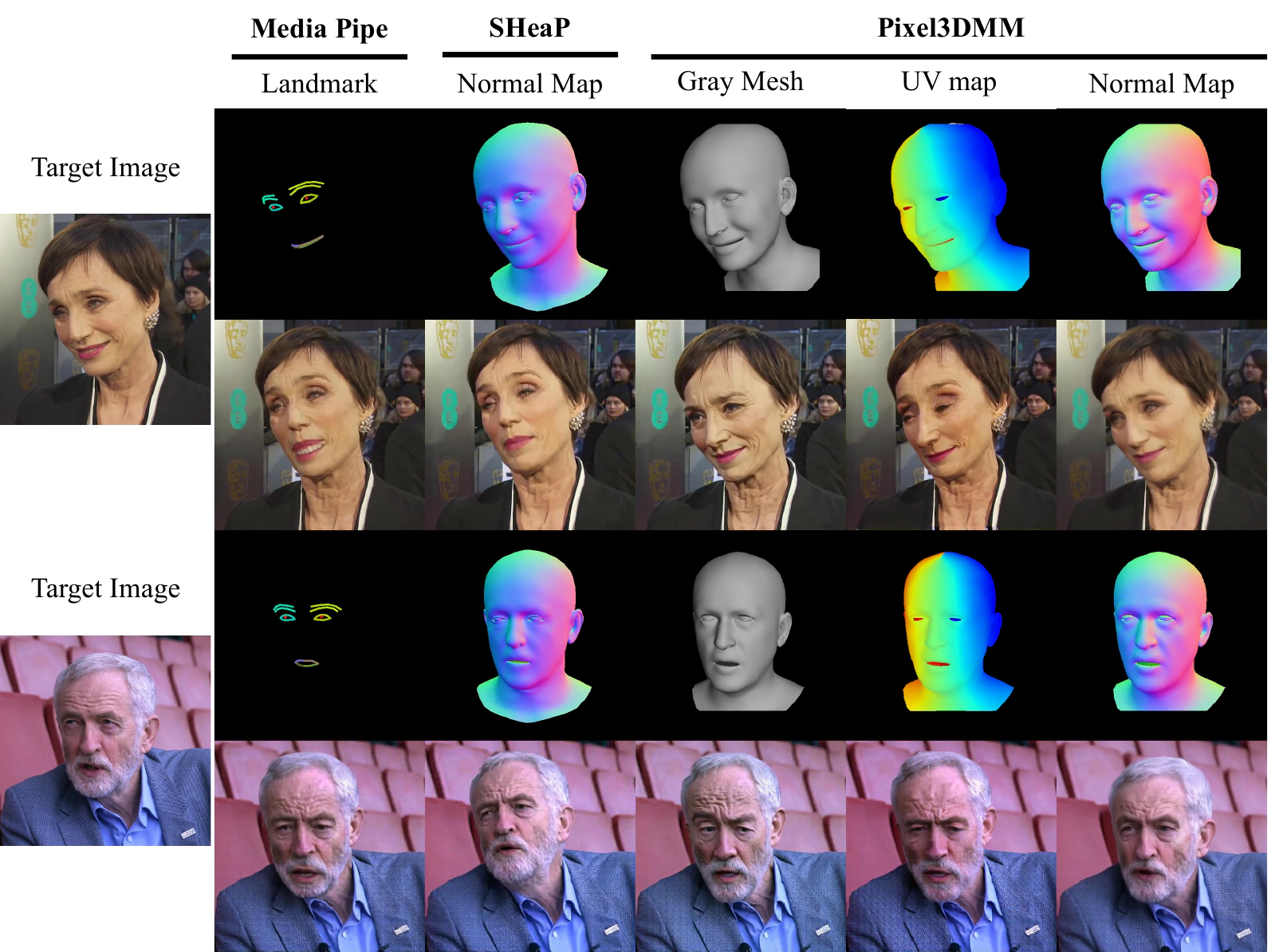
We compare MediaPipe landmarks, SHeaP normals, and three Pixel3DMM renderings. Landmarks are too sparse for precise control, while UV maps and gray meshes omit fine local surface detail. Pixel3DMM normal maps provide the strongest overall balance of identity preservation and expression transfer.
Reference Shape Parameters
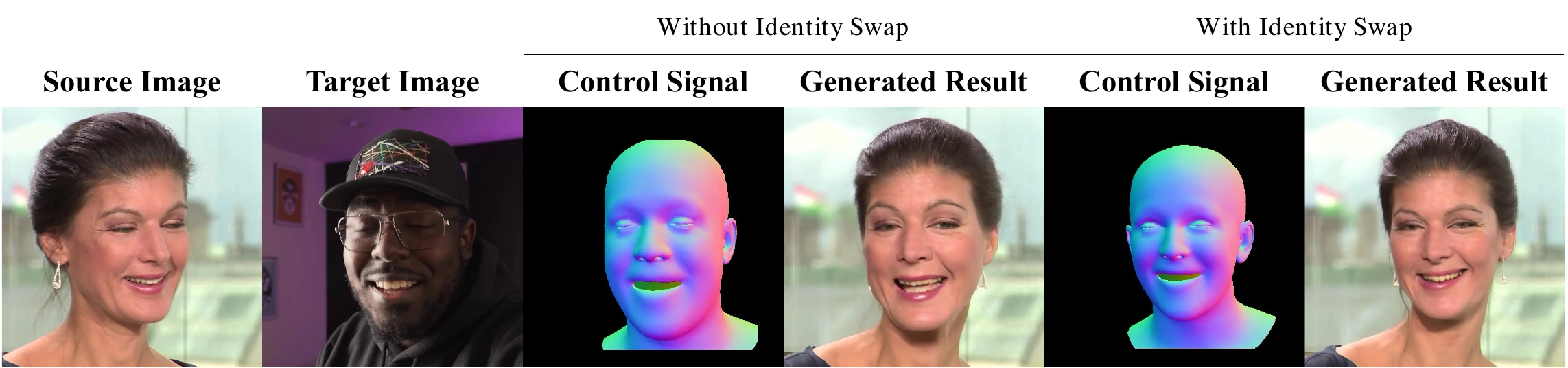
Keeping the reference subject's 3DMM shape parameters is important for identity preservation. Using the driving subject's shape produces inaccurate proportions and contours; swapping in the reference identity restores the intended facial structure.
Citation
@misc{ji2026vidsvideodiffusionshader,
      title={ViDS: Video Diffusion Shader using 3D Face Tracking},
      author={Wenbo Ji and Davide Davoli and Zhe Chen and Liam Schoneveld and Matthias Nießner and Jiapeng Tang},
      year={2026},
      eprint={2607.24124},
      archivePrefix={arXiv},
      primaryClass={cs.CV},
      url={https://arxiv.org/abs/2607.24124},
}